Why now
The grid wasn't built for AI workloads.
AI needs gigawatts of firm power within a few years. The grid takes years to say yes, if it can say yes at all.
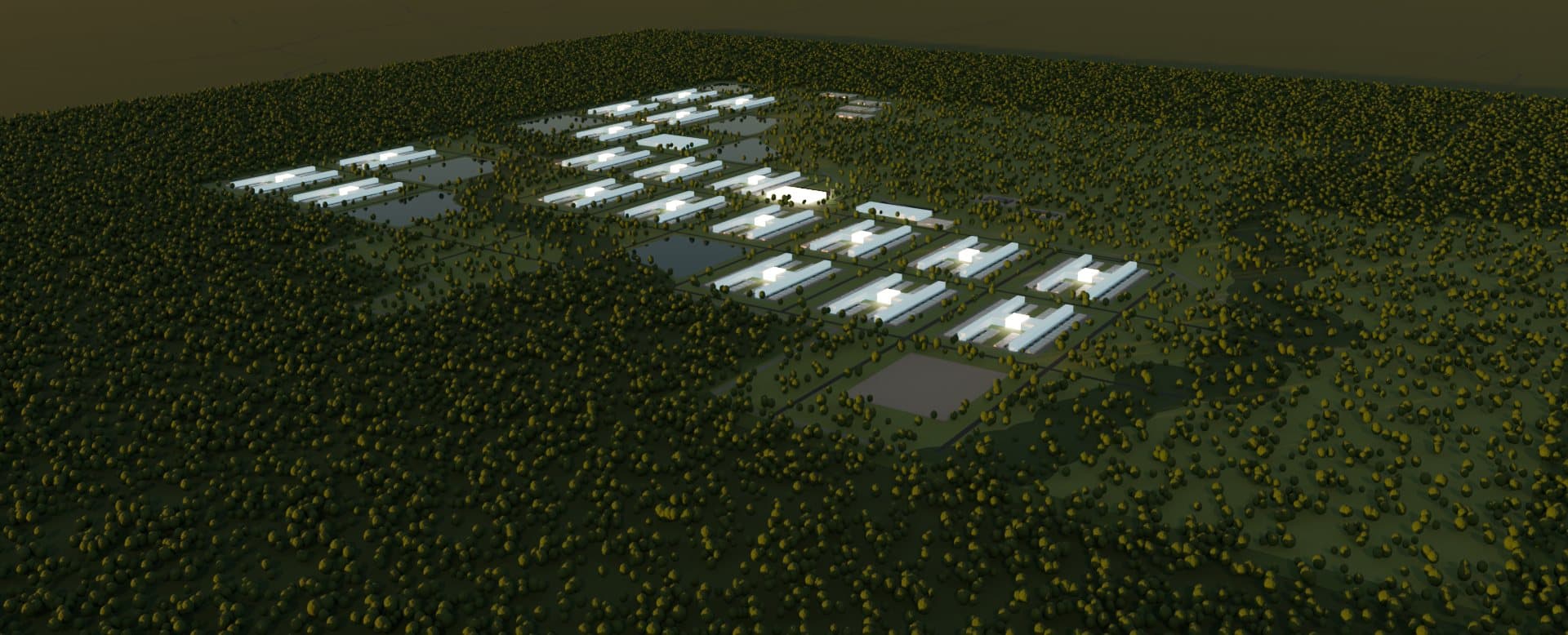
01 / Waiting in line
Years between request and power.
In Northern Virginia, Dominion estimates roughly four to seven years for a new large data center connection.[1]
Generators face a queue too. Berkeley Lab found that the typical project built in 2024 spent 55 months between its interconnection request and commercial operation, compared with 36 months in 2015 and 22 months in 2008.[2]
02 / Transmission
The lines are not keeping up.
Nearly 4,000 miles of high-voltage transmission were completed in 2013. In 2024, fewer than 900 miles of 345 kV-and-above lines were built; federal planning findings imply a need for roughly 5,000 miles each year.[3]
03 / Grid strain
Ratepayers feel the pressure.
NERC projects summer peak demand rising by more than 224 GW over ten years, 69% above its previous forecast. Thirteen of 23 assessment areas face resource adequacy challenges, with AI and data center load driving most of the increase.[4]
PJM capacity prices for 2025/2026 cleared at $269.92/MW-day, up from $28.92/MW-day.[5]
04 / Demand
AI demand is outpacing supply.
US data centers consumed 4.4% of the nation’s electricity in 2023. DOE projects 6.7% to 12% by 2028.[8]
The IEA expects worldwide data center electricity use to more than double to about 945 TWh by 2030, slightly more than Japan uses today. Data centers account for nearly half of US electricity demand growth over that period.[9]
05 / The bottleneck
Speed to power changes the equation.
Chips, capital and customers are ready. Firm, reliable power is the constraint DGEI was built to solve.
Waiting on the grid 4–7 years¹
- Large-load request & queue position
- Load studies & cost allocation
- Transmission & substation upgrades
- Energization, if capacity exists
The DGEI standard No interconnection queue
- Site, fuel supply & permits
- Factory-built power blocks and H building, in parallel
- Commission capacity block by block
AI compute live, one 10 MW net IT block at a time →
Illustrative; not to scale. This comparison describes dedicated on-site generation. Grid-fed capacity, grid ties and export require utility service or agreements and approvals. Site schedules vary. First pipeline deliveries target Q1 2028, subject to development milestones; this is not a guarantee. ¹ Dominion estimate for Northern Virginia large-load connections; source 1.
Sources
Source list supplied in the October 14, 2026 content brief. Dates and figures should be rechecked before publication.
- Bloomberg / Yahoo Finance — Dominion connection waits, August 2024 ↗
- Berkeley Lab — Queued Up: 2025 Edition ↗
- Grid Strategies & ACEG — Fewer New Miles, July 2025 (revised) ↗
- NERC — 2025 Long-Term Reliability Assessment ↗
- PJM — 2025/2026 Base Residual Auction Report ↗
- Monitoring Analytics — Analysis of the 2025/2026 RPM BRA, Part G ↗
- Data Center Watch — Q1 2026 Report ↗
- US DOE / LBNL — US Data Center Energy Usage Report ↗
- IEA — Energy and AI, Executive Summary ↗